


Tourist attractions in Baia Sprie
Description of Baia Sprie
-documentary attested in 1329 when the Hungarian king Carol Robert grants privilegies to the inhabitants of the town. The latin name of Baia Sprie was Mons Medius (the Middle Mountain) and it was a free town belonging to the royalty
-during the centuries the town had different names: in 1348 CIVITAS MEDIO MONTIS, in 1360 MONTANA NOSTRA, in 1390 FELSOBANYA, in 1406 CIVITAS de MONTE MEDIO and later on, from XIX century (1851) keeps the hungarian name FELSOBANYA. The Romanian name Baia Sprie comes from the world "Baia"=mine and the latin word "Asper"=harsh, possibly with the significance that it was harsh to work in the local mines.
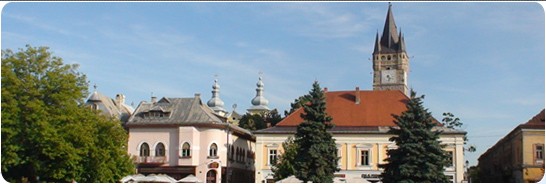
-the historical centre is formed by a number of old arhitectural monuments, built during XVIII and XIX century.
-the Town hall was errected in 1739 in a baroque style on the premises of an older Town hall distroyed by the Tatars in 1539. The two basement entrances display the coat of arms (two crossed hammers) and the year 1798
-the St Mary roman-catholic church located in Libertatii Sq. was build between 1846-1858 in a neoclassical style. The crosses on top of the two steeples are covered with gold.
-the reformed church build between 1889-1890
-the former salt mine office, 1733
-the Samuel Csaszi house errected in 1754 on a wood structure (nowadays baptist church)
-the roman-catholic chappel Calvaria - built in XVII century on Mine hill
Wooden churches of Baia Sprie
Traditional artisans of Baia Sprie
Les Daniel
Natural reserves and protected areas of Baia Sprie
Lacul Albastru
Restaurants and bars in Baia Sprie
Restaurant Medio Monte
Accommodation in Baia Sprie
Pensiunea Rustic
Pensiunea Casa Olarului